


“…he is being intentionally mysterious.”
“Effectively, so are you.”
“It is intercourse, Leo….Intercourse! The unbreakable taboo!”
“…he desires no visitors with sweeping reform.”
“Good for him!”
“I’m glad to listen to you say so.”
“Crime and the sensational!…We now have a sufficiency of each in New Orleans.”
“How the hell…can a person be shot via the pinnacle on the wheel of an car when there’s no person there to do it?”
–From The Ghosts’ Excessive Midday, by John Dickson Carr
I.
| Thriller Ladies |
Impressed by some current websites I noticed in Memphis I made a decision to try one of many final mysteries John Dickson Carr ever wrote: The Ghosts’ Excessive Midday, which is ready in New Orleans in 1912.
Memphis chances are you’ll know is about 400 miles up the Mississippi River from New Orleans and is the most important metropolis on the river between the Crescent Metropolis and St. Louis. A couple of weeks in the past in Midtown I got here throughout a brief road known as Carr Avenue. I prefer to think about it was named for John Dickson Carr, despite the fact that sadly that’s not the case. Nevertheless a lot of the houses on it have been constructed round 1912, lots of them New Orleans model shotgun homes for streetcar staff. Strolling down it, it is like being again in 1912. You may think about you’re in a interval Carr miracle thriller, with an car extremely getting into the avenue, then disappearing earlier than reaching the tip of it.
As Carr followers will know the locked room maestro in his writing turned more and more to historic mysteries with the publication of The Bride of Newgate in 1950, when he was 44 years outdated. Over the subsequent 22 years he printed solely 5 modern Dr. Fell detective novels, these in two transient spurts over 1958-60 and 1965-67, whereas his Sir Henry Merrivale detective novels petered out with a trio of volumes printed over 1950-53. In comparison with these eight books, he printed absolutely a dozen historic thriller novels over this two decade interval.

Carr suffered a considerably debilitating stroke in 1962 after publishing the historic thriller The Demoniacs, and, whereas his books had already suffered one thing of a decline within the Fifties, their high quality “fell” extra afterward. Like Agatha Christie an annual producer of a thriller tome (a Carr for Christmas), Carr may solely put collectively a group of beforehand printed brief tales for his 1963 outing and in 1964 he revised an older obscure historic thriller from the Thirties for publication. It was not till 1965, three years after the publication of The Demoniacs, that he was in a position to produce an unique quantity, The Home at Devil’s Elbow, in 1965.
Whereas in my view Elbow, a Dr. Fell thriller, is the most effective of the seven mysteries Carr printed between 1965 and 1972, the drop-off in writing high quality from earlier Fell tales, even In Spite of Thunder (1960), is unquestionably discernible. Anybody who reads my assessment of Thunder will see I did not prefer it a lot in any respect, and the reality is I truly loved Elbow extra for maybe sentimental causes of my very own; however I will readily concede it is a extra lumbering, listless narrative than what’s present in his earlier tales. Nevertheless, in comparison with the ultimate pair of Fell mysteries, Panic in Field C and Darkish of the Moon, which adopted over the subsequent two years, it virtually looks as if a masterpiece.
Panic and Moon share the overall issues from which Carr’s mysteries had been struggling for a while, elevated to the nth diploma: an excessive amount of discuss, an excessive amount of mysteriousness, irritating, adolescent characters who continuously act like idiots. Regardless of his insistence that he was one of many pillars of the true, simon-pure detective novel, Carr for a while had been littering his mysteries with as a lot irrelevant incident as any hard-boiled detective novel. Raymond Chandler might have suggested thriller writers that when stumped they need to have have a person come via the door with a gun, however with Carr it’s extra a maddening lady with a foolish, overblown secret or a load of some supernatural folderal.

In his heyday, Carr was in a position successfully to include such enterprise right into a thriller: novels like The Burning Courtroom (1937), The Crooked Hinge (1938) and He Who Whispers (1946) are compelling and atmospheric style masterpieces. However even earlier than his stroke Carr was fumbling the ball, because it have been. I will quote myself in my assessment of In Spite of Thunder:
Once more, for somebody who professed to hate hard-boiled mysteries, Carr evidently felt that in his story he needed to pile on incident (shouting and screaming if not precise fisticuffs and intercourse). If “Humdrum” mysteries can err on the aspect of being too cerebral, Carr’s books presently can err on the aspect of being too emotional. Carr is all the time telling us, as if we won’t inform for ourselves from all of the exclamation factors, that the emotional temperature within the room goes via the roof, and so on. Sure, there is a very heavy use of exclamation factors (!), what with characters shouting and roaring and crying “Sure!” and “No!” You simply need everybody to calm the f— down already.
Considered one of Carr’s most irritating quirks is to introduce the girl who’s performing mysteriously for what seems to be a remarkably inadequate purpose. The worst of those ladies is definitely Audrey Web page in In Spite of Thunder:
Audrey is a inventory character too, and never simply because she’s a younger and sexually engaging “heroine” and love curiosity. There may be nothing else to her persona moreover that she’s a maddening ditz. She’s there merely to bewitch and frustrate, to tantalize and tease, the hero, Brian, via a sequence of annoyingly capricious actions. This type of factor grew to become a given in Carr novels, however the issue right here is that Audrey actually is exceptionally irksome even by Carr’s commonplace of irksome ladies. “I have been very foolish, you realize, and I’ve behaved about as stupidly as anybody may behave,” she admits to Brian. Sure, certainly you’ve got, Audrey! However does that cease her from persevering with to behave that means? As a Carr character would say: “No, no, a thousand occasions no!”
We study that Audrey got here to Geneva merely to get Brian Innes to chase after her, as a result of, you realize, she merely could not inform Brian she cherished him, I assume. It is fascinating that Carr expressed hatred for hard-boiled crime fiction, as a result of characters like Audrey behave so much like femmes fatales in these books, present solely to bedevil the hero, although in the end Carr’s younger “charmers” normally show to be good ladies in any case, simply moderately maddeningly flighty and infantile. She “started to slap on the desk like a girl in a frenzy or a toddler in a tantrum,” writes Carr of Audrey at one level, mentally likening ladies to kids in an unflattering comparability.
All Brian and Audrey do the entire ebook (till the very finish) is bicker. This “battle of the sexes” motif is a distinguished function in later Carr (certainly it options in earlier Carr too), nevertheless it’s so rattling obtrusive on this novel. It is onerous to grasp simply why these two love every other–they definitely do not appear to love one another, What they actually need is just not a homicide investigation however a relationship counselor:
“However cannot you s-say you like me,” Audrey cried out at him, “with out swearing at me and searching as if you needed to strangle me?”
“No I am unable to. That is the way you have an effect on individuals.”
“All proper. I do not thoughts; I like it.”
Brian tells Audrey, within the anachronistically stilted language characters during which male characters converse on this ebook, “You are a feminine satan, a succubus of near-thirty masquerading as nineteen….I have been on the lookout for you my complete life.” What a charmer! I assume Audrey, who appears to have masochistic tendencies, cherished that endearment as effectively.
Audrey is probably the most tiresome of those she-witch Carr characters, however they pop up time and again. We’ll get to extra within the books I will speak about beneath.
However Carr has all kinds of tiresome quirks within the later books, all of which have been famous by Douglas G. Greene in his masterful Carr biography, The Man Who Defined Miracles, printed thirty years in the past this yr. There are the radio-script model stage instructions, a carry-over from his work in that area within the Forties and Fifties. Carr was most likely the best radio thriller author who ever lived, even higher than Ellery Queen and Anthony Boucher, however what labored in radio does not work in novels.

In his narrative Carr will embrace these lengthy descriptions of home layouts which learn like radio stage instructions; whether or not put in his characters’ mouths or within the third individual narrative, it is tedious writing certainly. Then he’ll cease a chapter with some type of contrived climax after which open the subsequent chapter a number of hours later with characters speaking about what occurred within the intervening interval, promptly deflating his climax.
However there’s a lot discuss typically it is onerous ever for Carr to maintain the joy he’s going for. It does not assist that the characters converse so anachronistically and floridly and oracularly. Carr does a factor I name “dashing,” the place he has a personality about to inform one thing pertinent to the thriller, solely promptly to interrupt him or herself with some sidetrack, like this:
“However you merely should hear this minute what I lastly have come to understand, the valuable golden key to the thriller that all of us in our various fumbling methods have been striving so desperately to know as a way to unlock this devilish puzzle field of a conundrum! The rationale no footprints have been left within the mud within the armaments room room of the citadel was–“
“Is that the tea kettle I hear whistling?”
Then 5 chapters later, if we’re fortunate, this individual, if they are not aren’t murdered within the meantime, might get round to telling what they know.

All of those faults are current within the earlier Fell mysteries In Spite of Thunder and The Useless Man’s Knock, however Panic in Field C and Darkish of the Moon (and The Home at Devil’s Elbow to a lesser extent) take these and add some extra. At the least within the earlier books Carr was in a position to generate a type of artificial pleasure, even when he was making an attempt a lot too onerous. These later books are simply boring, the characters tiresomely verbose and foolish, the narratives prolix, the climaxes duds. The characters behave like juveniles (or immature faculty college students), even calling one another by foolish nicknames. In Darkish of the Moon Dr. Fell will get known as magister, maestro, gargantua, Torquemada and different phrases I am unable to recall. It simply makes me need to tear my hair out.
A part of the issue was Carr simply couldn’t believably painting the modern scene, with which he himself was fully out of kinds. More and more he put his heroes’ ages of their thirties and even forties, whereas making his heroines shy of thirty (although they normally “look nineteen”); but none of them, nonetheless outdated, sound like precise individuals who may have lived within the mod period.
Fortunately Carr lastly dropped Dr. Fell and the fashionable world after Moon and his final 4 novels–Papa La-bas, The Ghosts’ Excessive Midday, Lethal Corridor and The Hungry Goblin–were set previously, two within the Victorian period and two in 1912 and 1927 respectively. Are they any higher? I have never learn The Hungry Goblin, which the property oddly has repressed from republication, apparently on the grounds that it’s such a horrible ebook (may it actually be worse than Darkish of the Moon?), however I might say that the New Orleans trilogy of novels is at the least a little bit higher than the ultimate two Fells.


II.
The primary of those novels, Papa La-bas, launched Carr’s New Orleans trilogy of thriller novels. It is an enchancment over Panic and Moon, nevertheless it’s nonetheless not truly good. It displays all the issues of his later books, if considerably much less conspicuously than the earlier two.
 |
| Delphine LaLaurie (colorized) |
There was truly materials right here to make a very good ebook, had the youthful Carr written it. Set in 1858, shortly earlier than the outbreak of the American Civil Battle (or Battle Between the States as Carr, like Raymond Chandler, all the time known as it), the novel attracts on the infamous actual life case of Delphine LaLaurie, a New Orleans socialite believed to have tortured and murdered lots of her slaves.
An infuriated metropolis mob truly invaded and razed her mansion in 1834, forcing her to flee the state and the nation and settle in Paris, the place she died fifteen years later. In Carr’s novel it seems pretty early on that LaLaurie’s adopted son–a character invented by the author–has returned to New Orleans to avenge himself on the mob’s ringleaders, all of whom are socially distinguished males (in Carr’s dealing with).
As said, that is good materials for a thriller melodrama, however sadly none of it ever actually takes flight, being held down by the prolix, tedious narrative. Carr introduces voodoo–or extra precisely rumors of voodoo–but this by no means actually goes anyplace, regardless of a lot point out being product of actual life New Orleans “Voodoo Queen” Marie Laveau.

In a short time the ebook descends into characters dully orating at one another, together with the ebook’s nominal novice detective, traditionally distinguished real-life southern politician Judah Benjamin (nicknamed “Benjie” within the ebook). The fictional character Isabelle de Sancerre, a rich slave proudly owning matron, goes on and on to equally fictional English (truly Scottish) consul Richard “Dick” Macrae about numerous New Orleans legends. Even Carr refers to this girl within the ebook’s Notes for the Curious as “that tireless talker.”
Then as love pursuits there are two younger women–Margot de Sancerre, Isabelle’s willful southern belle daughter, and Ursula Ede, her steadfast second banana pal (what I name in Carr’s books the brunette one and the blonde one)–both of whom are behaving maddeningly mysteriously.
There’s not a lot nicknaming on this one, although Ursula insists on calling Dick “Quentin” for some purpose. There are a few inventory English comedian cockney characters who vexsomely converse in ponderously overdrawn dialect. The homicide technique within the killing of Decide Rutherford (a cameo character who exists solely to be killed) Carr presumably cribbed from a Dorothy L. Sayers novel, whereas the central concealment gadget for the assassin he most likely derived from a sure opus by Cornell Woolrich, an creator with whom he had qualities in widespread. I feel it turns into screamingly apparent who the assassin is round web page 100, but unrelentingly the ebook goes on.
All in all it is one other drained work by Carr. One factor this time round I observed (it is my second learn) that I assumed was form of humorous, nonetheless: Dick has two buddies, Tom Clayton and Harry Ludlow, whom he goes to a “quadroon ball” with; and it lastly occurred to me this time that collectively they’re “Tom, Dick and Harry.”

Talking of quadroons (individuals one-fourth black), Carr mainly appears to view slavery as roughly on par with the outdated English class system of masters and servants. (It is how southern slave-holding “aristocrats” favored to view themselves, nonetheless self-deceivingly.) This does not add one bit to the attraction of the ebook, to say the least. When a personality casually mentions having received himself a slave in a card recreation, nobody bats an eyelash. The basic inhumanity of all of it Carr does not appear to get.
At one level our good English consul, the “hero” of the story, so lectures his underling Harry when he thinks (wrongly) that Harry is about to object to the morality of quadroon balls, that are attended by comely free “mulatto” ladies in hopes of discovering rich white males to make mistresses of them:
“The scenario exists, and have to be confronted; let’s don’t have any moralizing or cant!”
 |
| “The Quadroon” 1911 poem by black reformer W.E.B Du Bois |
Effectively, is not that particular? Really it is fairly clear that each one three males are moderately sexually titillated by these balls. In fact they’re all sexists as effectively, considering spanking is an effective way of disciplining willful, headstrong ladies like Margot, who shockingly exhibits up on the ball too, despite the fact that she is just not of blended race. Conversely, little drawback apparently is seen with lovely ladies having primarily to promote themselves sexually as a result of they’ve in them some drops of “black blood.” The scenario, in accordance with Dick, have to be confronted, nevertheless it needn’t be confronted and corrected, apparently. Inform that to W.E.B. Du Bois. (See pic to left.)
Reformers, in any case, are only a bunch of self-righteous sermonizers, proper? Nothing greater than a sourfaced pack of puritanical blue noses and spoilsports.
Did Carr see all ethical stances as cant (i.e., sanctimonious lecturing), or simply those he himself did not care about personally? What about, say, concern over genocide or pedophilia? (On the latter matter see beneath.) Elsewhere Dick Macrae sneeringly refers to objecting to slavery as singing “pious hymns” and Harry Ludlow broadcasts: “I am unable to be as shocked by slavery as individuals at residence suppose I must be.”
Judah Benjamin, a real-life character whom Carr clearly admires, when queried about his convictions on the topic, states: “I don’t say slavery is fallacious, as I don’t say any property proudly owning is fallacious.” In actual life Carr like Benjie was an amazing defender of the rights of property homeowners and he thunderously damned British postwar taxation as iniquitous oppression. Maybe he was proper about this. However to not respect that human property belongs in a special class from mere inanimate objects is what appears really iniquitous to me. To remove somebody’s impartial personhood via enslavement strikes me as one of many worst sins one can commit.
 |
| Judah Benjamin a proslavery Jewish US senator from Louisiana on the time Papa La-bas takes place |
Doug Greene in his Carr biography states that social programs per se didn’t bother Carr, although he did suppose one had an obligation to behave “honorably” inside them: i.e., masters mustn’t mistreat servants, freed or enslaved, like Delphine LaLaurie allegedly did. There is a gambler character who behaves badly to Dick’s free black servants and is upbraided by Dick for doing so.
But certainly generally social programs are so dangerous that they must be drastically reformed; particular person acts of kindness do not do practically sufficient to mitigate the general evil of the system in place. However Carr and the characters with whom he sympathizes in his books are all self-proclaimed “conservatives” who instinctively oppose social reform as dangerously “radical.”
Carr himself, like his dearest enemy Raymond Chandler, professed to take the a part of the Confederacy within the American Civil Battle, likening southerners to his beloved English cavaliers; and in his later years he left England to settle in Greenville, South Carolina, of all locations, the place he praised the southern states as bedrocks of conservatism and sarcastically dismissed considerations about civil rights as lurid exaggerations. (My household moved to Alabama the identical yr however my dad and mom by no means deluded themselves like Carr concerning the actuality of the area’s endemic racism.)

III.
In comparison with Papa La-bas, The Ghosts’ Excessive Midday is definitely one thing of an enchancment, and never simply because we aren’t having slavery thrown in our faces. (In slavery’s place we get one thing else odious and objectionable thrown in our faces; see beneath.) Carr truly repeats a few of the plot factors from Papa, however he at the least comes up, this time round, with a reasonably good and apparently unique “unimaginable” homicide.
 |
| houses alongside Bayou Saint John, scene of crime in The Ghosts’ Excessive Midday |
It is 1912 and our hero, James “Jim” Blake, is an admired journalist turned profitable spy novelist. His lately printed debut novel, a bestseller, is The Depend of Monte Carlo. Carr right here alludes, precisely sufficient, to the English crime author E. Phillips Oppenheim, who had already turn out to be a massively well-liked creator in the USA along with his tales of worldwide intrigue in Monte Carlo and different swanky European locales.
In New York Jim is requested by George Brinton McClellan Harvey, an actual life distinguished conservative Democrat (quickly to turn out to be a Republican) and editor of Harper’s Weekly, to report on rumors of political intrigue in a congressional race in New Orleans regarding Democratic nominee Jim Clayton “Clay” Blake. “The underground wire has it that some enemy is out to damage him,” Harvey explains.
 |
| Carr’s form of man distinguished anti-progressive George Harvey |
Clay, Harvey tells Jim, is “like most southerners…as conservative as you’re.” (Harvey means white southerners after all.) Jim himself confirms, with out clarification: “I am a conservative, even a reactionary…I mistrust progressives and hate reformers.”
113 years in the past close to the peak of the Progressive Period, there was a lot, one would possibly consider, that wanted reforming, such because the franchise (ladies couldn’t vote) and racist Jim Crow legal guidelines, however not so to our Jim Blake, who, conveniently for himself, does not truly like speaking about politics. If he did, he may need to articulate defenses of a few of his heinous positions!
However anyway off goes Jim by practice to New Orleans, with a cease at Washington, D.C., which permits Carr to indulge himself in some nostalgia about streetcars and such. (He lived in DC as a small boy when his father briefly served as a US congressman–a Democrat!)
Chunks of exposition have already been served as much as Jim and the reader by George Harvey; and in DC but extra is ladled out by Charley Emerson, an outdated bachelor whose pursuits, sounding so much like Carr, are “outdated books and toy trains.” Then it is off to New Orleans!
Alongside the best way on his New York journey Jim actually twice runs into fetching, fair-haired Jill Matthews, for whom in Carr custom he instantly falls emotionally. Sure, it is one other certainly one of Carr’s age-mismatched romances, Jim being thirty-five and “not ill-looking in a strongly Anglo-Saxon means [?]” and Jill being twenty-seven and “very fairly” with “admirable physique proportions” and “a humorousness struggling via” her delectable “pink mouth.” Very quickly Jim is moderately familiarly calling Jill “my sugar-candy witch,” a type of bizarre anachronistic endearments (even for 1912 I believe) for which Carr had a penchant. Certainly, this phrase appears distinctive to Carr. Girls additionally get known as “wench” so much in his books.
 |
| suffragist Aimee Hutchinson was fired from her instructing job at a Catholic college for attending a suffrage parade in 1912, the identical yr as The Ghost’ Excessive Midday. (See right here.) Carr’s hero in that novel is a self-described reactionary who firmly opposes sweeping social reform. |
Jill, nonetheless, justifies the endearment (?) when she maddeningly retains operating away all through a lot of the ebook. When she explains her conduct a lot afterward, her clarification hardly appears enough. Sadly this not very compelling subsidiary thriller round vanishing Jill swallows a lot of this ebook, just like the proverbial gnat swallowing the whale.
There may be finally a “miracle” homicide nevertheless it’s not till round web page 200 in a 300 web page ebook that Carr actually will get critical with it. There’s additionally the supposed “miracle” thriller of the one that knocked on the door of the practice compartment the place Jim, Jill, and a New Orleans bon vivant pal of Jim’s, Leo Shepley, are discussing the Clay Blake matter after which vanished, however this little thriller, by no means very compelling within the first place, fizzles miserably. At the least it does not take up as a lot of the ebook because the matter of Jill’s Jilting Habits.

Jim lastly will get to New Orleans on web page 84 and the homicide of Leo Shepley takes place about fifty pages later. Witnesses, together with Jim and Jill, see him drive down the Bayou St. John street in his snazzy crimson Mercer Raceabout right into a barn-like shed on the grounds of a mansion after which hear him apparently shoot himself. However, wait, the place’s the gun?! Might it’s homicide?!
I nonetheless like miracle issues (Carr at his finest is an abiding delight on this regard) and this was an pleasurable one, a lot better than the shenanigans in Papa La-bas, the place there are additionally a surfeit of mysteries, together with Margot’s vanishing from a transferring carriage, and never a single certainly one of them compelling.
 |
| “The Mercer Raceabout is taken into account probably the most prized unique American sports activities automotive. Recognized for its enhanced design, magnificent dealing with and excessive pace, these vehicles received 5 of six races they entered in 1911. Mercers got here with the remarkable assure that every Raceabout would obtain a minimal of seventy miles per hour with out modification on public roads.“ See Heritage Museum and Gardens |
I discovered the interval environment in Midday pleasurable sufficient, although lots of the characters within the ebook sound extra like callow Nineteen Twenties faculty college students (like Carr, now 63, had been 4 a long time earlier) moderately than Edwardian adults. That is how Jim and Leo greet one another on the practice:
 |
| New Orleans’ Resort Grunewald setting for a late tete-a-tete between Jim and Jill |
“Leo, you outdated bastard, how are you?”
“Jim, you unregenerate son-of-a-bitch, have you ever visited any good whorehouses lately?”
Later this boyish pair sits down in a compartment with Jill, have drinks and chat about whores and homosexuals. Jill is Carr’s good kind of woman, the type that appears prim and correct on the surface, however is basically means into intercourse beneath (even wanton), pally with the boys and sympathetic to all of her beau’s charmingly masculine foibles.
She’s the form of woman you possibly can throw up on on the faculty soccer recreation if you’re drunk out of your thoughts and she’s going to gamely smile and wipe your vomit off her gown with a handkerchief (or extra possible a number of of them).
“I would like you to do mad issues,” Jill admiringly tells Jim. “I like it!” Remembering that she’s dwelling within the Edwardian period, she will not smoke in public, nonetheless, at the least till late within the ebook.
 |
| Jim and Jill share a romantic rendezvous at The Cave, a fantastic grotto-like eating room within the Grunewald Resort |
IV.
In a very good variety of later Carrs, illicit intercourse between older males and youthful ladies (or “ladies” as they’re known as) is a central curiosity. And naturally within the case of Ghosts’ Excessive Midday the setting is New Orleans, which had an notorious red-light district generally known as Storyville, so Carr has come to the correct place! I do not know of any critiques explicitly mentioning this (or Doug’s bio both) however the illicit intercourse on this one takes place between grownup males and what Carr refers to as “pubescent ladies” across the ages of 12 or 13, which raises the “ick” issue significantly.
Worse but, Carr adopts the identical angle to baby prostitution that he does to the quadroon balls: judiciously impartial, if one desires to be beneficiant, although one would possibly extra precisely say pruriently . Regardless of dwelling on this topic at appreciable size in his novel, in his Notes for the Curious Carr himself fully avoids the topic of Storyville baby prostitution. Did the topic spring totally from his personal thoughts?
 |
| Storyville prostitute photographed by E. J. Bellocq |
The Inexperienced Capsule in its assessment of the novel very delicately and disapprovingly approaches this matter: “There’s a notably vile topic needlessly included within the story, and I am not even going to say what it’s. That Carr treats it with a “males will likely be males” angle is past me, and I may think about some readers simply shutting the ebook.”
Effectively, I will dare to debate this “vile topic” in depth beneath, so take heed. You may draw your personal conclusions as to what it says concerning the creator. Carr appears to intimate {that a} sexual predilection for younger ladies, at the least when the women are ostensibly “keen” contributors, is moderately much less aberrant than homosexuality.
This take first comes up when Dick, Leo and Jill are discussing the Clay Blake affair. The rumors about Clay Blake concern “one thing irregular or unnatural,” speculates Jim. “The slightest suggestion of homosexuality, for instance….” This hypothesis provokes an infuriated Leo to smite his fist on the desk, rattling the glasses and china.
“What sort of buddies do you suppose I’ve, for God’s sake?” Leo roars. “No, Jim, I will not hear that for a minute! It is nothing in any respect irregular or unnatural, at the least in the best way you imply.“
.jpg)
So Leo objects to Jim suggesting he may need homosexual buddies, however pedophiles (or near-pedophiles) are a-ok, apparently. In a while in New Orleans Jim discusses with a few Crescent Metropolis pressmen the prison case of Etienne Deschamps, a New Orleans dentist who in 1892 was tried and executed on the age of 62 for the homicide three years earlier, when he was 59, of 13-year-old Juliette Deitsh. (She was truly, contra Jim/Carr, 12.) Dr. Deschamps had a behavior of chloroforming and sexually assaulting Julia, however sooner or later he administered an excessive amount of chloroform to her and he or she died.
 |
| Jerry Lee Lewis and his “half-grown nymph” Myra |
Jim declares of younger Juliette that Deschamps “made the woman his mistress” and that “she appears to have entered heartily into the affair and had all of the important attributes of a girl.” Pardon the canting and pious hymning right here, however is not this stance moderately on the grotesque aspect?
Okay, I will permit that in Mississippi in 1957 22-year-old rock singer Jerry Lee Lewis married a 13-year-old cousin and that underneath the English widespread legislation of rape the age of consent was set at twelve and even ten, which means that if a person had intercourse with a twelve-year-old, the woman was compelled to show that she had not consented to her bodily violation to ensure that the act to be deemed rape. So Carr’s angle is definitely a standard one and everyone knows Carr cherished custom.
Nonetheless Carr was writing in 1969 not 1669, for God’s sake. Again within the Fifties Jerry Lee Lewis’ profession suffered a big setback over his marriage. (It did not assist that the couple have been cousins as effectively.) Okay, lawyer Alan Dershowitz, infamous Jeffrey Epstein pal, in a 1997 newspaper editorial, “Statutory Rape is an Outmoded Idea,” pronounced: “Cheap individuals can disagree whether or not the age of consent needs to be as little as 14. Fifteen would appear like an applicable compromise.” However even he wasn’t going for 12.
On Carr goes about this topic all through this ebook. Later Jim visits Flossie Yates, a New Orleans madam who focuses on procuring younger ladies for her purchasers, what Carr calls “pubescent ladies,” presumably which means they’ve “all of the important attributes of a girl.” Flossie chattily talks of two such ladies, Sue, who’s 14, and Billie Jean (had Michael Jackson learn this ebook?), who is just not a lot over 12. Billie Jean, she declares, “is exceptionally mature for her years.” She calls her charming ladies “half-grown nymphs.”

Different characters, when this matter comes up (which it does continuously), name them “the close to nubile” and refer blithely to Flossie’s “steady of underage ones” and “the fun of the pubescent” and “males with a ardour for half-formed our bodies and the caresses of the immature.” Clay Blake explains that he was “accused of spending my nights in orgies with ladies twelve or 13 years outdated. Do not look so shocked, any of you.” He provides this despite the fact that, Carr pointedly tells us, “actually no person did look shocked; the ladies merely seemed considerate.” Girls in Carr’s books attempt onerous to look correct, however underneath the pores and skin, they’re, just like the colonel’s girl one imagines, drastically , maybe much more than males, in intercourse of all stripes.
.jpg) |
| Storyville |
V.
Let me clarify that I am not suggesting that Carr was, like occasional thriller author Eden Phillpotts. a secret pedophile. Really, to be correct, I’ve found that the technically correct time period for what Carr is describing, an individual interested in pubescent kids (versus pre-pubescent kids), is hebephile. I am not even saying Carr was a type of both, like these fictional purchasers of Sue and Billie Jean in The Ghosts’ Excessive Midday. But to me a whole lot of the notions expressed about intercourse in Carr’s books come off as juvenile, sexist, prurient and sometimes disgusting.
Others have agreed. “Intercourse amateurish and repulsive on the identical time,” wrote Humdrum thriller devotee Jacques Barzun in his and Wendell Hertig Taylor‘s tome A Catalogue of Crime of Carr’s 1949 detective novel Under Suspicion, although satirically The Ghosts’ Excessive Midday was one of many few Carrs Barzun truly favored. “Considered one of his sober and sustained efforts,” he declares. (Barzun does not point out the kid prostitution both.) Of Midday particularly a nonplussed Keith Boynton at Goodreads avowed, “the story’s cavalier angle in direction of pedophilia is fairly rattling jarring.“
Time and again Carr’s later novels function older males interested in a lot youthful ladies, typically ladies who “look about nineteen.” Then there’s this very sexualized and smitten description of Girl Brace within the The Cavalier’s Cup (1953), who enticingly appears for all of the world like jailbait, although she truly is not. Evidently an actual dream woman fantasy in excessive heels:
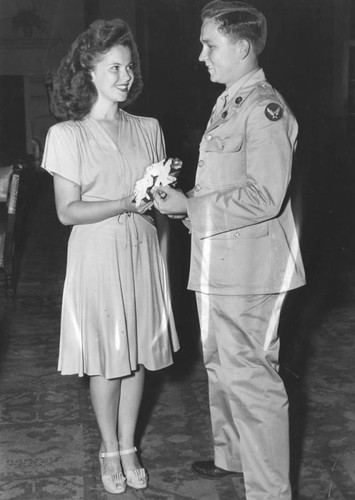 |
| Actress and “small woman” Shirley Temple receiving a corsage on her fifteenth birthday in 1943. Like Carr’s Girl Brace, her hair “fell to her shoulders and curled out a little bit in artless, young-girl style.“ Six years earlier, when Temple was solely 9 years outdated, creator Graham Greene had scandalously asserted in a movie assessment that Temple’s “admirers” consisted of “middle-aged males and clergymen“ who have been interested in her “well-shaped and fascinating little physique.“ |
The very fairly woman who entered [Chief Inspector Masters’] workplace, he would have sworn at a primary fast look, couldn’t have been greater than fifteen years outdated, regardless of her modish garments.
To begin with, even sporting her heels she was solely 5 ft tall. Her gentle and silky light-brown hair fell to her shoulders and curled out a little bit in artless, young-girl style….
[…]
“I am awfully sorry to intrude, Chief Inspector stated the small woman, in a heat and candy voice as female as herself. “However do you thoughts if I sit down?”
[…]
….her determine…was a high quality one….for all its harmless and demure look, her expression held a top quality of the impish. The small woman…used her moderately heavy-lidded grey eyes and pink lips in a means which might have impressed hypothesis in any man who had been married for fewer years than Chief Inspector Humphrey Masters.
1953 was the time, I’ve speculated, that Carr, a fortunately married but perpetually dissatisfied man who engaged in numerous extra-marital affairs or assignations, was having a midlife disaster. (He was 47.) In his books and his life in his later years he appears to have been obsessive about recovering the unrecoverable previous, the world’s and his personal, wanting desperately to relive the fun of his misplaced youth, when life had extra zest.
 |
| All of the important attributes of a girl? Brooke Shields as a toddler prostitute within the 1978 movie Fairly Child |
Again to The Ghosts’ Excessive Midday, late within the novel police detective Zack Trowbridge, who calls Jim Franz Joseph (do not ask), admits that the police know all about Flossie Yates and her underage woman harem. Why is not she prosecuted? It appears that evidently “if the women are proved professionals [!] it is onerous to the touch anyone.” So these decidedly professional younger ladies stay available to to gratify the lusts of “anyone who’s received the dough.” Storyville, it appears, is an ideal island of depravity, moderately just like the late Mr. Epstein’s literal one.
(The crimson mild district was lastly shut down in 1917 when the US entered World Battle One and established a navy base in New Orleans. The federal government emphatically didn’t need the troops dallying with Storyville whores. My then twenty-one-year-old paternal grandfather, by the way, was stationed down there on the time.)
Curiously 5 years after the looks of The Ghosts’ Excessive Midday, Louisiana author Al Rose printed Storyville, a historical past of New Orleans’ crimson mild district which included an account of a younger woman who was pressured into prostitution by her personal mom. The account in flip served because the inspiration for the 1978 film Fairly Child, which starred precise twelve-year-old mannequin and actress Brooke Shields because the titular baby prostitute. Carr died the yr earlier than the discharge of this flick at age 71, so he by no means received see how his then forgotten novel anticipated some of the controversial movies of the Seventies. To me all this provides sudden piquancy to The Ghosts’ Excessive Midday, nonetheless problematic Carr’s take with reference to baby prostitution is.


