

A 1001 MIDNIGHTS Evaluation
by Max Allan Collins
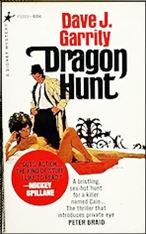
DAVE J. GARRITY – Dragon Hunt. PI Peter Braid. Signet, paperback unique, 1967.
Dave Garrity appears unfairly destined to be a footnote within the profession of Mickey Spillane. With the exceptional reputation of Spillane within the Fifties, a gaggle of satellite tv for pc writers sprang into orbit round him: “buddies” of the Mick’s who solicited cowl blurbs and contacts within the writing enterprise to launch their very own careers as hard-boiled thriller writers.
Earle Baskinsky flamed out after two vivid, idiosyncratic novella-length books (The Massive Steal and Dying Is a Chilly, Eager Edge, each 1956), as did Charlie Wells, after two readable, Spillane-imitative books (Let the Night time Cry, 1954, and The Final Kill, 1955).
Solely Garrity — who typically printed below the single-name by line Garrity — carved out a profession of his personal. His solely printed private-eye novel to dale (a number of novels accomplished shortly earlier than his dying in 1984 may even see posthumous publication) is Dragon Hunt, through which he unashamedly tapped into the success of Mike Hammer.
Though Dragon Hunt is considered one of Garrity’s lesser works, it has been singled out for dialogue as a result of it options Mike Hammer as a personality, making it of curiosity to college students of Spillane, whose significance is, in spite of everything, plain.
With Spillane’s blessing (proper right down to cowl blurb and a photograph of the Mick and Garrity on the again cowl), the novel that “introduces personal eye Peter Braid” ties immediately into the world of Mike Hammer in some ways. The title is a reference to “the dragon,” the villain of Spillane’s novel The Lady Hunters> (1961), to which Dragon Hunt is vaguely a hack-door sequel.
All through the novel Braid calls Hammer on the cellphone for recommendation and assist, maybe mirroring the Garrity/Spillane relationship. (Spillane claims to not have supplied Hammer’s dialogue, however one assumes he not less than checked it over.)
The essential plot — a dying millionaire named Adam hires the PI to guard his granddaughter from a prodigal, psychotic son named Cain — is lifted from the syndicated “Mike Hammer” sketch in 1954, proper right down to the names of the characters. Spillane wrote the Sunday pages of the strip and collaborated with artist Ed Robbins on the day by day scripts.
In his entry in Modern Authors circa ’63, Garrity mentions as a piece in progress a e-book that’s clearly Dragon Hunt — then titled Discover the Man Known as Cain — to be finished in collaboration with Ed Robbins. This could clarify the Hammer strip as supply materials for the novel, however not the dearth of Robbins’ identify on the by-line. In any case, Dragon Hunt is a minor, barely tongue-in-cheek, however likable affair, and a should for Spillane fans.
Those that want to see Garrity at his finest, nonetheless, ought to search out his Cordolini sequence for New American Library. In these 4 novels (an unpublished fifth one is understood to exist), Garrity reveals himself to be an bold author, experimenting with characterization by way of quirky efficient dialogue; utilizing third-person shifting viewpoints boldly; and customarily avoiding the schlocky mock”Executioner” strategy of comparable sequence of the identical interval.
His best hour is The Plastic Man (1976), which incorporates a narrative trick so deft, so stunning, that probably the most seasoned thriller reader should give Garrity his due.
———
Reprinted with permission from 1001 Midnights, edited by Invoice Pronzini & Marcia Muller and printed by The Battered Silicon Dispatch Field, 2007. Copyright © 1986, 2007 by the Pronzini-Muller Household Belief.

