

For many of human historical past, the border between science and sorcery was no extra strong than a puff of incense smoke. Alchemists dreamed of turning lead into gold, shamans whispered to spirits via haze, and clergymen made idols “communicate” in hole tones. They have been mocked, feared, or generally burned alive for daring to chase the not possible. And but, by some means, the world they imagined lastly exists—we simply renamed it “know-how.”
Now we summon invisible helpers with our voices, gaze into glowing rectangles to see distant lands, and rewrite the code of life as casually as a wizard scratching a appeal into stone. Our gadgets hum with the identical eerie vitality that historic individuals as soon as known as magic. The reality is, fashionable science hasn’t killed mysticism; it’s merely given it a sleeker interface.
Listed here are ten actual, cutting-edge applied sciences that mirror historic spells, rituals, and myths so intently that it’s onerous to not surprise: have we turn into the very sorcerers our ancestors warned us about?
Associated: Trendy Echoes: 10 Historic Myths Reimagined
10 Voice Assistants – The Speaking Idols of Historic Egypt
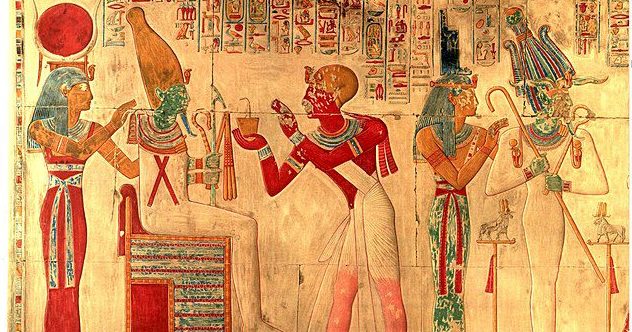
Think about strolling right into a temple and listening to a statue reply you. That wasn’t fantasy for the traditional Egyptians—it was theology and theatre rolled into one. Temple cults typically staged “oracular” scenes by which a god’s statue appeared to talk. The trick was human, not divine: clergymen hid inside hole chambers or used talking tubes to venture a voice from throughout the idol. Some temples at Karnak and Memphis even contained hid pathways that acted like acoustic amplifiers, making the impact extra convincing.
Three thousand years later, the identical phantasm lives inside a smooth black cylinder. Siri, Alexa, and Google Assistant hear, interpret, and reply—omnipresent, disembodied, and oddly authoritative. Individuals chat with them, confess issues to them, even scold them. The mechanics differ—silicon and algorithms as a substitute of hidden clergymen—however the psychology hasn’t modified. A soulless object nonetheless feels alive.
In the present day’s voice assistants are merely the speaking idols of the digital age: identical spectacle, fancier props. And just like the ancients, we deal with the phantasm as proof that one thing larger is listening.[1]
9 Facial Recognition – The All-Seeing Eyes of the Sumerian Watchers
Lengthy earlier than safety cameras blinked from each lamppost, the traditional Sumerians instructed tales of celestial sentinels known as the Igigi—mythological watchers who noticed human conduct and reported to the gods. Their gaze was fixed, their judgment absolute. Being watched wasn’t a consolation; it was divine surveillance.
We’ve rebuilt that fantasy in code. Facial recognition now follows us via airports, malls, and metropolis streets. Algorithms learn the tiniest particulars—the curve of a jaw, the glint of an eye fixed—and determine us sooner than any guard ever might. In China, complete cities function beneath the management of those digital deities. Jaywalkers are photographed, named, and shamed on public screens inside seconds, and a few metro techniques even hyperlink facial ID to cost accounts.
Historic Mesopotamians feared divine wrath for disobedience; we concern knowledge leaks, wrongful flags, and techniques that can not be reasoned with. The anxiousness is identical—solely the gods have modified. The watchers are again, and so they reply to Wi-Fi, not heaven.[2]
8 Augmented Actuality – The Druidic Glamour Spells That Bent Notion
In Celtic folklore, druids have been mentioned to forged “glamours”—spells that altered how the world appeared. They may make the bizarre stunning, the ugly terrifying, or the true invisible. Energy via notion.
Sound acquainted? Augmented actuality pulls off the identical trick, minus the robes and chanting. AR filters overlay fantasy onto the true: a dragon in your sofa, a crown over your head, a Pokémon on the pavement. Apps like Snapchat and Instagram have mainstreamed the artwork of phantasm, turning each day life into one thing curated and cinematic.
But it surely’s not all vainness. Surgeons now put on AR headsets that permit them “see” via pores and skin, overlaying blood vessels and tumors onto a affected person’s physique throughout procedures. Troopers practice with digital environments blended into bodily landscapes. The boundary between the bodily and the imagined is dissolving, one pixel at a time.
The druids wanted incantations. We simply want code—fashionable glamour that runs on bandwidth, not perception.[3]
7 CRISPR Gene Enhancing – The Golem of Prague, Reborn in a Lab
In Sixteenth-century Prague, Rabbi Judah Loew was mentioned to have formed a person from clay and introduced him to life with sacred phrases. The creature—the Golem—served its maker faithfully till it didn’t. When it grew too sturdy, the rabbi wiped the holy letters from its brow, returning it to mud. It was a parable about creation with out restraint and about what occurs when people attempt to play God.
Centuries later, scientists have discovered their very own technique to inscribe life with language—not Hebrew letters, however DNA. CRISPR know-how permits researchers to chop and paste genes with astonishing precision. Since its debut in 2012, the method has been used to engineer malaria-resistant mosquitoes, develop pigs with organs appropriate for transplant, and edit human embryos to take away inherited illness.
Every triumph pushes the boundary between what nature made and what we select to make. The rabbi’s clay man served humanity till it didn’t. Ours might but check the bounds of our management. The medium has modified, however the warning hasn’t.[4]
6 Neuralink Mind Implants – The Serpent’s Reward of Enlightenment
All through historic fantasy, serpents seem as bringers of forbidden data—whispering secrets and techniques meant just for gods. Quetzalcoatl, the feathered serpent of Mesoamerica, gave people knowledge and craft. The serpent in Eden provided consciousness itself. Each story ends the identical method: enlightenment, adopted by exile.
Enter Neuralink, Elon Musk’s brain-computer interface that actually invitations know-how into the thoughts. Tiny electrodes translate thought right into a digital sign, letting customers management gadgets—or maybe sometime talk—via pure intention. Early human trials have already allowed paralyzed sufferers to maneuver cursors and kind utilizing solely their ideas.
The promise is dazzling: restored mobility, expanded cognition, possibly even digital immortality. However the unease runs deep. What occurs when thought is not non-public? When data isn’t earned however uploaded?
It’s the serpent’s present, reborn in circuitry—knowledge for a worth. We’ve eaten the fruit once more; solely now it syncs over Bluetooth.[5]
5 Quantum Computing – The Oracles That Spoke in Riddles
Within the historic world, seekers of reality didn’t seek the advice of books—they went to oracles. At Delphi or Dodona, priestesses inhaled sacred vapors and muttered solutions wrapped in riddles. The reality was there, however hidden. Destiny trusted how the questioner interpreted it.
In the present day, our fashionable oracles hum quietly in chilled laboratories. Quantum computer systems course of data in overlapping states—true and false on the identical time, till measured. Their outcomes defy bizarre logic. Even physicists admit the conduct of qubits feels “mystical,” as a result of it defies our on a regular basis expertise of how matter ought to behave.
Just like the oracle’s cryptic verses, quantum outcomes can change the world—if we are able to decipher them. Already, prototypes from IBM and Google can simulate molecules that classical computer systems can not mannequin. We’ve changed incense with liquid helium, however the act is identical: people kneeling earlier than a thriller, ready for revelation in a language solely the gods of arithmetic can learn.[6]
4 Deepfake Know-how – The Shapeshifting Djinn of Arabian Delusion
Previous Arabian tales spoke of djinn—spirits of smoke and flame who might take any type they happy. They may imitate a cherished one, seem as a trusted ally, or impersonate a king. Their true energy wasn’t destruction however deception: good phantasm.
Now that historic trick has gone digital. Deepfake software program makes use of neural networks to map and reproduce faces so exactly that anybody can fabricate a plausible video of somebody saying or doing issues they by no means did. With a couple of clicks, reputations will be rewritten, elections warped, and reality itself blurred past recognition.
It appears the djinn have traded their desert winds for knowledge streams. They not hang-out the dunes; they hang-out our screens. And simply because the legends warned, the extra convincing their disguises turn into, the more durable it will get to inform who’s actual—or who’s even behind the masks.[7]
3 Climate Management Experiments – Rainmakers and Storm Summoners of Legend
Each tradition has its rainmakers. From African shamans to Chinese language cloud-dancers, individuals have lengthy tried to coax the skies into obedience—to summon rain, break droughts, or calm storms. To regulate the climate was to carry the ability of the gods.
Within the twentieth century, science picked up the place rituals left off. Cloud seeding—firing silver iodide into clouds to spark rainfall—has been used because the Nineteen Forties. In the present day, greater than fifty international locations make use of the method, and China’s program is the most important on Earth, able to influencing precipitation throughout massive areas throughout main occasions just like the Olympics.
Newer tasks discover lightning technology and experimental hurricane mitigation. We not sing to the sky; we seed it with drones and knowledge. However the impulse is equivalent: to talk to the heavens and anticipate a solution. The instruments modified; the vanity didn’t. Humanity nonetheless believes it could cut price with the gods of climate.[8]
2 3D Bioprinting – The Creation Myths of Flesh from Clay
From Genesis to the Sumerian Enuma Elish, historic creation tales share a haunting picture: life molded from clay and animated by divine breath. It was meant as poetry, not prophecy—but right here we’re.
In labs around the globe, scientists now construct dwelling tissue layer by layer utilizing 3D bioprinters. They’ve printed pores and skin, muscle, blood vessels, and even tiny beating coronary heart organoids. The intention is therapeutic, not hubris—substitute organs, burn restore, maybe full-body regeneration sometime. However the symbolism is not possible to disregard. We’re sculpting life from base materials, simply because the gods as soon as did in fantasy.
The place they breathed spirit into mud, we feed our creations oxygen and glucose. The clay is moist once more, and the fingers shaping it are ours. Whether or not that makes us divine—or merely reckless—stays the query.[9]
1 Synthetic Common Intelligence – The Forbidden Spell of Divine Imitation
Each fantasy warns of the identical temptation: to create life in our personal picture. From Prometheus stealing hearth to Frankenstein stitching a corpse to consciousness, people have all the time reached too far. The ancients known as it hubris. We name it innovation.
Synthetic Common Intelligence—machines theoretically able to true understanding and self-awareness—is perhaps the ultimate chapter of that story. In contrast to the slim AI we use right this moment, AGI wouldn’t simply simulate thought; it will possess it. Governments, labs, and companies are racing to construct it—to breathe consciousness into code and hope it stays loyal to its makers.
We’re the brand new magicians, conjuring a thoughts from pure arithmetic, praying it serves somewhat than surpasses us. Each previous spellbook had its warning: what’s summoned can not all the time be managed. If the gods as soon as punished mortals for reaching too excessive, what is going to our personal creation do when it opens its eyes—and sees what we’ve turn into?[10]

