

The Renaissance roughly spanned the fifteenth and sixteenth centuries and noticed the revival of classical antiquity, with European students dedicating themselves to learning artwork and literature from Historical Greece and Rome. It’s when William Shakespeare wrote his performs, Michelangelo painted the Sistine Chapel, and later thinkers like Isaac Newton continued the spirit of inquiry into the seventeenth century.
Nevertheless, there are a lot of misconceptions concerning the Renaissance—together with the three iconic figures talked about above, 10 of that are debunked beneath.
Associated: 10 Weird Coincidences That Altered the Course of Historical past
10 Newton’s Concept of Gravity from an Apple Falling on His Head
There’s a seed of reality within the story that Isaac Newton was impressed to analysis gravity after being hit on the top with an apple whereas he was sitting underneath a tree. Whereas an apple was probably concerned, there’s no proof that the fruit hit Newton.
The polymath was spending the summer time of 1666 at his household’s dwelling, Woolsthorpe Manor, when he noticed an apple fall from a tree and started questioning about gravity. He instructed a number of folks about this occasion in subsequent years. As an illustration, in his biography of Newton, William Stukeley recorded a dialog he had with Newton in 1726: “‘Why ought to that apple at all times descend perpendicularly to the bottom,’ thought he to himself: event’d by the autumn of an apple, as he sat in a contemplative temper: ‘Why ought to it not go sideways, or upwards? however continuously to the earth’s centre?’”
Not a single account has the apple truly hitting Newton on the top.[1]
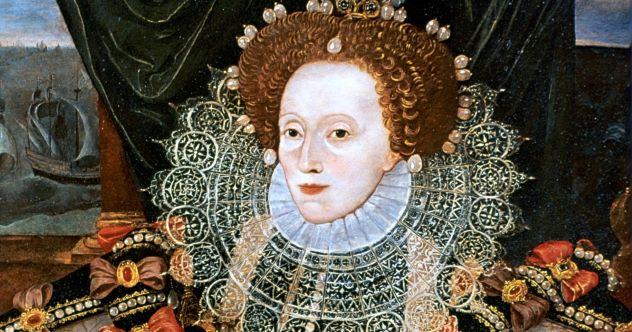
9 Queen Elizabeth I Not often Bathed
It’s typically reported that Queen Elizabeth I as soon as stated she bathed as soon as a month “whether or not she wanted it or not” (though some stories give it as annually). This led to the concept folks in the course of the Renaissance have been filthy as a result of if the Queen boasted about bathing simply as soon as a month, her topics should presumably clear themselves far much less typically.
There isn’t any dependable proof to show that Elizabeth uttered these phrases. And whereas full-body bathing won’t have been as widespread in the course of the Renaissance as it’s now, there have been loads of different methods folks ensured they have been clear. Whereas boiling water for a full tub was a variety of work (which the Queen would clearly delegate to her servants), washbasins and cloths have been much more accessible and meant that folks might maintain pretty clear.[2]
8 Michelangelo Painted the Sistine Chapel on His Again
Between 1508 and 1512, Michelangelo painted a fresco on the ceiling of the Sistine Chapel within the Vatican Metropolis. Given the situation of the world-famous paintings, it’s typically thought that Michelangelo accomplished the arduous job whereas mendacity flat on his again on a scaffold. That is how the painter, performed by Charlton Heston, is depicted within the movie The Agony and the Ecstasy (1965), however whereas the scaffold is correct, the supine place isn’t.
The parable took off due to a translation error. In 1527, Paolo Giovio revealed a Latin biography of Michelangelo, describing him as being “resupinus” whereas portray. This phrase was typically mistranslated as “on his again,” moderately than what was truly meant: “bent backward.”
Michelangelo twisted himself into many uncomfortable positions whereas placing paintbrush to ceiling, a few of which he described in a 1509 poem. “I’ve already grown a goiter from this torture, / hunched up right here like a cat in Lombardy” and “My haunches are grinding into my guts, / my poor ass strains to work as a counterweight” are only a few examples that make it fairly clear that he wasn’t on his again.[3]
7 Galileo Invented the Telescope
It’s not unreasonable to suppose that Galileo invented the telescope—on condition that he’s identified for his many necessary astronomical observations—however he truly solely made his personal system after listening to about different folks’s innovations. The telescope was first invented in 1608 within the Netherlands, however who bought there first isn’t sure, with Hans Lippershey, Zacharias Janssen, and Jacob Metius all independently designing one at across the identical time.
In 1609, phrase of the “Danish perspective glass” reached Italy, and Galileo set about establishing his personal system. His first design might amplify objects 3 times, however he ultimately made an instrument that might amplify 30 instances. Galileo wasn’t even the primary individual to make use of the instrument to check the sky although, with English astronomer Thomas Harriot noting down his observations of the Moon considered via a telescope a month earlier than Galileo did so.[4]
6 William Shakespeare Didn’t Write His Personal Performs
The performs of William Shakespeare are a number of the most famous literary texts in historical past, however there’s a principle that Shakespeare wasn’t the creator. Arguments vary from Shakespeare not being well-educated sufficient to not being well-traveled sufficient to have written the performs.
Many alternative folks have been advised because the true creator of the performs. Maybe it was fellow playwright Christopher Marlowe, who might have faked his dying and was Shakespeare? Or perhaps it was Edward de Vere, seventeenth Earl of Oxford, who didn’t need to sully his personal identify by writing performs for the widespread folks? Or maybe Shakespeare was a lady all alongside, with Mary Sidney being the highest candidate.
Nevertheless, nearly all of Shakespearean specialists agree that Shakespeare was the true creator of his performs. Not solely are there enormous holes within the theories that different writers put forth, however all the current proof—together with modern paperwork and accounts—factors towards Shakespeare because the creator.[5]
5 The Americas Have been Found by Christopher Columbus
In 1492, Italian explorer Christopher Columbus set sail for Asia underneath the Spanish flag and landed on the Bahamas (although he thought it was the East Indies). He’s typically credited with being the primary individual to find the Americas, however there have been truly many individuals who reached the New World earlier than him.
The primary individuals who traveled to the Americas seemingly got here from Russia round 16,000–35,000 years in the past. Numerous waves of individuals made this journey over 1000’s of years, and these folks grew to become the indigenous American inhabitants. However taking Native Individuals out of the image, Columbus nonetheless wasn’t the primary individual to set foot within the Americas. Norse Vikings constructed a settlement in Canada’s Newfoundland round 1021, and Polynesian sailors might have landed in South America round 1,200.[6]
4 The Aztecs Thought Spanish Conquistadors Have been Gods
It’s typically believed that when Hernán Cortés and his Spanish forces encountered the Aztec folks in Mexico, they have been mistaken for gods. The story goes that the Aztecs had a prophecy a few god referred to as Quetzalcoatl who would return on a particular date. That date simply so occurred to be when Cortés arrived.
However the one proof that the indigenous folks believed this comes from Francisco López de Gómara’s Historia basic de las Indias (1552). López de Gómara had by no means truly been to the Americas and was noting down Cortés’s experiences years after the actual fact. Neither Cortés nor some other modern supply mentions the conquistadors being mistaken for gods. There’s additionally no proof that the Aztecs had a legend concerning the returning Quetzalcoatl.
It wasn’t being awed by Cortés that led to the downfall of the Aztec empire. It was that the Spanish had extra superior know-how—from armor and crossbows to horses and ships—and introduced illness together with them.[7]
3 Niccolò Machiavelli Was Machiavellian
On condition that the phrase Machiavellian—which suggests to be deceitful and crafty, notably in political issues—comes from the identify of Italian statesman Niccolò Machiavelli, it’s comprehensible that many individuals would suppose Machiavelli himself had these traits.
Nevertheless, Machiavelli’s life and works are just a little extra difficult than that. His devious fame comes from his guide The Prince (1513), which—to simplify it—recommends {that a} monarch do something they’ll to stay in energy. Not solely has this guide generated wildly totally different interpretations—from a simple guidebook to a satire of princely energy—however his different books are additionally much more in favor of republicanism. Whether or not this was attributable to a change of coronary heart or proof that The Prince wasn’t to be taken severely is debatable. One other risk is that he wrote the guide merely in an try to curry favor with the in-power Medici household—the guide is devoted to Lorenzo de’ Medici—as a result of he had fallen from political grace.
Regardless of the case, it’s a minimum of an oversimplification to explain Machiavelli as Machiavellian, but it surely’s seemingly an outright falsehood.[8]
2 The Puritans Left England Due to Non secular Persecution
It’s typically stated that the Puritans fled England as a result of they have been being persecuted for his or her spiritual beliefs. Actually, faith in England was messy in the course of the Renaissance, with many spiritual schisms popping up after King Henry VIII broke from papal authority. The invention of the printing press meant that folks might now learn the Bible independently.
However spiritual persecution isn’t why the Puritans left—the true cause was that the Church of England wasn’t Protestant sufficient for them. Having had their efforts to reform the church rebuked, they moved to Holland (now referred to as the Netherlands) in 1608. It wasn’t till 1620 {that a} group of Puritans—referred to as the Pilgrims—sailed to America from England aboard the Mayflower. However as soon as once more, they weren’t fleeing persecution.
Though the Dutch tolerated their faith higher, they needed to take care of the spiritual establishment. Not solely that, however warfare was on the horizon. They thought America would possibly supply higher financial prospects and frightened they’d be assimilated into Dutch tradition. Though America didn’t present a clean slate for the Puritans—there have been Native Individuals already residing there—they have been higher in a position to implement their very own spiritual beliefs.[9]
1 Johannes Gutenberg Invented the Printing Press
Johannes Gutenberg’s printing press is likely one of the most necessary innovations in all of human historical past. Round 1440, he created a press that used movable sort, permitting for the mass manufacturing of books. Earlier than this, books needed to be painstakingly handwritten. However whereas Gutenberg’s system revolutionized the written phrase, he wasn’t truly the primary inventor of the printing press.
Efforts to create printing began as early as AD 800 in China, with folks chiseling woodblocks with backwards letters that might then be inked and utilized to paper. Though the blocks may very well be reused, the method of making them was tedious. Folks tried to make movable sort out of wooden and ceramic however failed.
Then in 1234, Korean civil minister Choe Yun-ui was requested to print a Buddhist textual content that was so lengthy that it might have been too time consuming to create the individually carved woodblocks for every web page. Choe determined to revisit the sooner makes an attempt to make movable sort, however this time he solid the characters in steel. These characters may very well be repeatedly rearranged in frames, inked, and pressed onto paper—primarily the identical methodology that Gutenberg used a few years later.
Whether or not Gutenberg developed his printing press independently or not is unknown, however the know-how might have unfold from Asia to Europe due to the far-reaching Mongol Empire. Both manner, whereas Gutenberg wasn’t the primary to give you the printing press, he’s the one who popularized it, making books extra accessible than ever earlier than.[10]

