

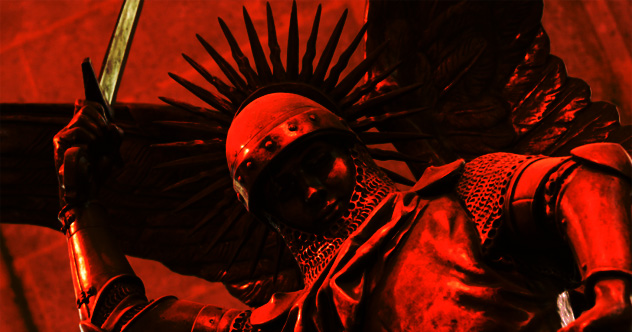
Demise is part of life, however that doesn’t imply it isn’t a terrifying idea. Practically each tradition has sought to ease fears about this scary however essential a part of existence by creating myths and legends that assist clarify what occurs within the afterlife. You’ve already heard about paranormal psychopomps just like the Grim Reaper and Baron Samedi, supernatural specters just like the Banshee and the Cú Sìth, and angels and gods of demise. However there are nonetheless so many extra. A few of them soothe, whereas others horrify—and nearly the whole lot in between. Maintain studying for 10 extra representations of demise from fantasy and legend.
Associated: 10 Tales from Gnostic Mythology
10 Ankou – The Grave Watcher
The everlasting, accursed Ankou roams western France, particularly Brittany, amassing souls and guiding them to the afterlife. His skeletal determine unsettles unfortunate passersby as he carries departed souls in a creaking cart pulled by black horses. Wearing a black hooded cloak or dusty boots and a hat with a brim large sufficient to shade a whole funeral occasion, Ankou’s hole eyes and razor-sharp scythe full a glance that screams demise incarnate.
Regardless of his haunting look, Ankou shouldn’t be malevolent. Every village is alleged to have its personal Ankou, who serves solely as a information between worlds. In some Breton traditions, the primary particular person to die in a village turns into the Ankou for the approaching 12 months; in others, it’s the final. Both approach, he retains the cycle of life and demise turning.
One standard story tells of a younger man who mocked Ankou as he handed by. Moments later, the youth discovered himself sitting within the demise cart among the many souls. Ankou advised him, “I acquire the outdated to make room for the younger.” The warning delivered, the younger man was restored to life—now humbled, and without end modified.[1]
9 The Dullahan – Harbinger of Demise
Some of the haunting figures in Celtic mythology is the Dullahan, a headless horseman and harbinger of demise. He rides an enormous black stallion, carrying his personal severed head beneath one arm, its hideous grin stretching from ear to ear and its eyes glowing like coals within the night time.
The Dullahan seems solely in darkness. His arrival is alleged to be preceded by a sudden chill, pounding hooves, and an unnatural shadow that appears to swallow the moonlight. Although generally described as a impartial messenger of destiny, many concern him as a relentless, vengeful spirit.
Based on legend, if the Dullahan calls out somebody’s identify, that particular person’s demise is for certain. Individuals historically protected themselves by retaining gold close to their doorways and home windows—one of many few issues the Dullahan is alleged to keep away from. His whip, constituted of a human backbone in some tales, strikes concern in anybody who dares cross his path.
Trendy tradition has saved his legend alive by means of movies like Sleepy Hole, anime, fantasy novels, and video video games, the place he seems as a terrifying antagonist or a sorrowful, cursed wanderer.[2]
8 Mictecacihuatl – Goddess of Demise
Aztec legend hyperlinks the delivery of Mictecacihuatl—generally known as the Girl of the Useless—to the creation of the world itself. Alongside her husband, Mictlantecuhtli, she guidelines Mictlan, the Aztec realm of the lifeless. Whereas he enforces the legal guidelines of the underworld, Mictecacihuatl embodies compassion and safety for the just lately departed.
She helps information souls by means of the 9 treacherous ranges of Mictlan, the place the journey can take years to finish. Her skull-like face and darkish apparel symbolize her dominion over demise, but she additionally carries motifs related to the moon and rebirth, such because the coyolxauhqui adornments seen in some depictions.
Mictecacihuatl’s affect extends into fashionable tradition—notably Día de los Muertos. She is usually thought-about a religious ancestor to symbolic figures like La Catrina, representing each remembrance and the acceptance of demise as an important a part of life.[3]
7 Thanatos – God of Demise
Thanatos, whose identify actually means “demise” in Greek, is the traditional god of peaceable, pure demise. He seems for the time being of passing to softly information an individual’s spirit to the afterlife. He can’t be bribed or delayed and resists makes an attempt to cheat mortality, although a number of myths, just like the story of Sisyphus, describe uncommon exceptions.
In classical artwork, Thanatos is depicted not as a skeleton however as a winged, lovely younger man holding an inverted torch (symbolizing a life extinguished) or poppies, related to sleep and everlasting relaxation. Later depictions, particularly in fashionable media, generally deal with him like a Grim Reaper determine, however the Greeks seen him as dignified and serene.
Thanatos is the dual brother of Hypnos (Sleep), and their siblings embrace gods representing human feelings and ethical forces. His affect seems all through popular culture immediately, inspiring characters in Marvel comics, video video games like Persona and Hades, and numerous artistic endeavors and literature.[4]
6 Owuo – Spirit of Demise
Owuo is the spirit of demise in Akan custom, present in areas of Ghana and the Ivory Coast. Based on fantasy, people have been initially immortal—till Nyame, the supreme creator, determined that life wanted an finish and introduced Owuo into being. Not like many demise deities, Owuo doesn’t choose souls; he merely escorts them to Saman, the world of the ancestors.
Owuo’s look varies broadly. Some say he’s a darkish, formless presence felt solely by means of his actions. Others describe him as a shifting shadow related to pink and black, skulls, vultures, and the pure decay that accompanies demise. He’s the pressure guiding the residing to their households within the afterlife.
Custom holds that souls should cross a terrific river to achieve Saman. Owuo ensures the righteous arrive safely, whereas those that lived immorally wander as misplaced spirits. Some tales additionally depict Owuo carrying symbolic instruments—reminiscent of a workers or bone rattle—to sign his arrival and information souls on their closing journey.[5]
5 Izanami – Goddess of Yomi
In Japanese mythology, Izanami and her husband, Izanagi, have been among the many first gods to emerge when the world was created. Collectively, they shaped the islands of Japan and birthed many gods of nature, hearth, and the weather. Their tragic separation started when Izanami died giving delivery to Kagutsuchi, the hearth god.
Heartbroken, Izanagi descended into Yomi—the land of the lifeless—to retrieve her. However Izanami had already eaten the meals of the underworld, binding her to it without end. When Izanagi noticed her corpse, crawling with maggots and surrounded by thunder spirits, he fled in horror, sealing the doorway of Yomi behind him. Izanami then turned queen of the underworld and the arbiter of the lifeless.
Izanami’s story seems all through Japanese media, together with manga, anime, and video games. In some traditions, she can also be linked to illness and curses, whereas in others she stays a tragic determine outlined by love, loss, and the eerie stillness of Yomi.[6]
4 Malak al-Mawt – Angel of Demise
In Islamic custom, 4 archangels play main roles: Michael, Gabriel, Israfil, and the angel of demise, generally known as Malak al-Mawt. He harvests souls in response to God’s decree fairly than private judgment. Historical sources say he receives an inventory of the 12 months’s destined deaths shortly earlier than Ramadan, finishing up every appointment precisely as written.
Usually depicted as solemn and huge, Malak al-Mawt seems for the time being of demise to escort souls to the following world. Some traditions say he additionally witnesses the questioning of souls after demise. A well known saying attributed to him is “There isn’t a single family within the East or the West that I don’t go to 5 occasions a day,” underscoring his fixed presence.
Based on Hadith commentary, even prophets encountered him dramatically. One custom recounts Moses hanging the angel of demise so arduous that one among his eyes was displaced; Malak al-Mawt calmly restored it and provided Moses a peaceable passing close to the Holy Land. Whether or not literal or symbolic, these tales illustrate the angel’s steadfast nature and cosmic obligation.[7]
3 Ammit – Devourer of the Useless
Ammit is without doubt one of the most terrifying beings in historical Egyptian faith. Generally known as the Devourer, she has the top of a crocodile, the torso of a lion or leopard, and the hindquarters of a hippopotamus—three of Egypt’s most harmful animals mixed into one fearsome guardian of justice.
Within the Corridor of Two Truths, the deceased undergoes the “weighing of the center” ceremony. Anubis locations the center on one aspect of a scale and the feather of Ma’at—representing fact and justice—on the opposite. If the center is lighter, the soul could enter paradise. But when heavier, Ammit lunges ahead to devour it.
Some traditions say the consumed soul is destroyed solely; others declare the particular person turns into a stressed spirit, trapped in everlasting unrest. Regardless of her dreadful function, Ammit shouldn’t be evil—she is an enforcer of cosmic order, ready eagerly for Anubis to solid her the hearts of the unworthy.[8]
2 The Fetch – Messenger of Demise
Irish legend tells of the Fetch, a spectral double that seems as a residing particular person’s actual likeness—apart from one refined however unmistakable distinction. It strikes a fraction too slowly, or its options blur like a mirrored image in darkish water, or its voice sounds borrowed from a fading dream. As soon as seen, its message is evident: demise is close to.
The Fetch shouldn’t be malicious. Its sole function is to warn. After delivering its silent omen, it dissolves into nothing and by no means seems once more. On this approach, it differs from many deathly spirits, appearing extra as a messenger than a tormentor.
Folklore holds that the time of the Fetch’s look issues: seeing it at daybreak is an indication of lengthy life, however encountering it at nightfall foretells imminent demise. The Fetch seems all through Irish ghost tales and mythology, and the idea of a deathly double has influenced Doppelgänger tales throughout Europe.[9]
1 Morana – Goddess of Demise
Morana—also referred to as Marzanna or Morena—is the Slavic goddess of winter, demise, and nightmares. In fantasy, she ushers souls from the world of the residing to the realm of Nav, the Slavic underworld. However she additionally torments mortals of their goals, bringing illness, insanity, and misfortune to those that cross her path.
She seems in lots of types: a pale, ghostlike girl with hole eyes and tangled hair that mirrors her harmful energy, or a tall and exquisite determine wearing pink and black. Her duality displays the character of winter itself—quiet and exquisite, but unforgiving.
In Slavic folks custom, villages burned or drowned straw effigies of Morana on the finish of winter to welcome the spring, symbolically banishing demise and darkness. However fantasy warns that the goddess by no means leaves for lengthy. She instructions demise’s messengers and reminds mortals of her everlasting presence—particularly these daring sufficient to overlook her energy.[10]

